North Carolina Child Care Staff-to-Child Ratios: The Complete 10A NCAC 09 .0713 Guide
North Carolina licenses child care centers through the Division of Child Development and Early Education (DCDEE), part of NC DHHS. The rules live in 10A NCAC Chapter 09, with ratios and group sizes in Section .0713 (most recently amended November 1, 2024), and the statutory space minimums in N.C. Gen. Stat. §110-91.
North Carolina has a structural feature that sets it apart from nearly every other state covered in this series: operators get to choose which ratio regime they operate under. There are two complete, separate tables, and a center elects one.
Option 1: Single-Age Grouping (§.0713(a))
This is the default, and the one most centers use.
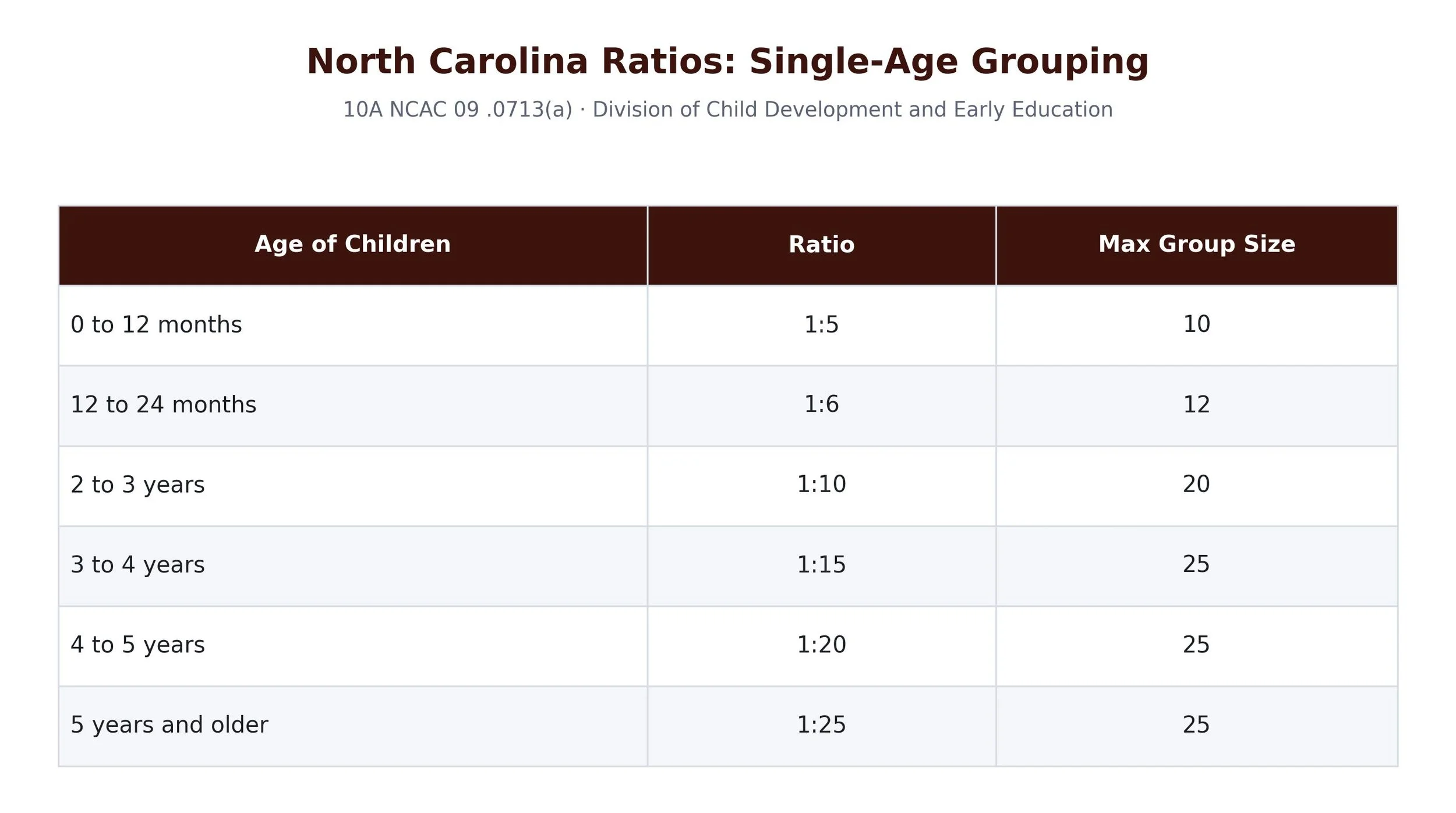
Notice something unusual in that right-hand column: the group-size cap plateaus at 25 from age 3 upward, even as the ratio keeps loosening. By the time you reach the 5-and-older band, the ratio (1:25) and the cap (25) converge exactly, meaning a single staff member covering a full-size group is the legal maximum, and adding a second staff member buys you no additional children in that room. Most states scale the cap alongside the ratio. North Carolina does not.
Option 2: Multi-Age Grouping (§.0713(d))
Centers may instead elect a multi-age structure, which requires written notification to the Division first. It comes with an entirely different table:
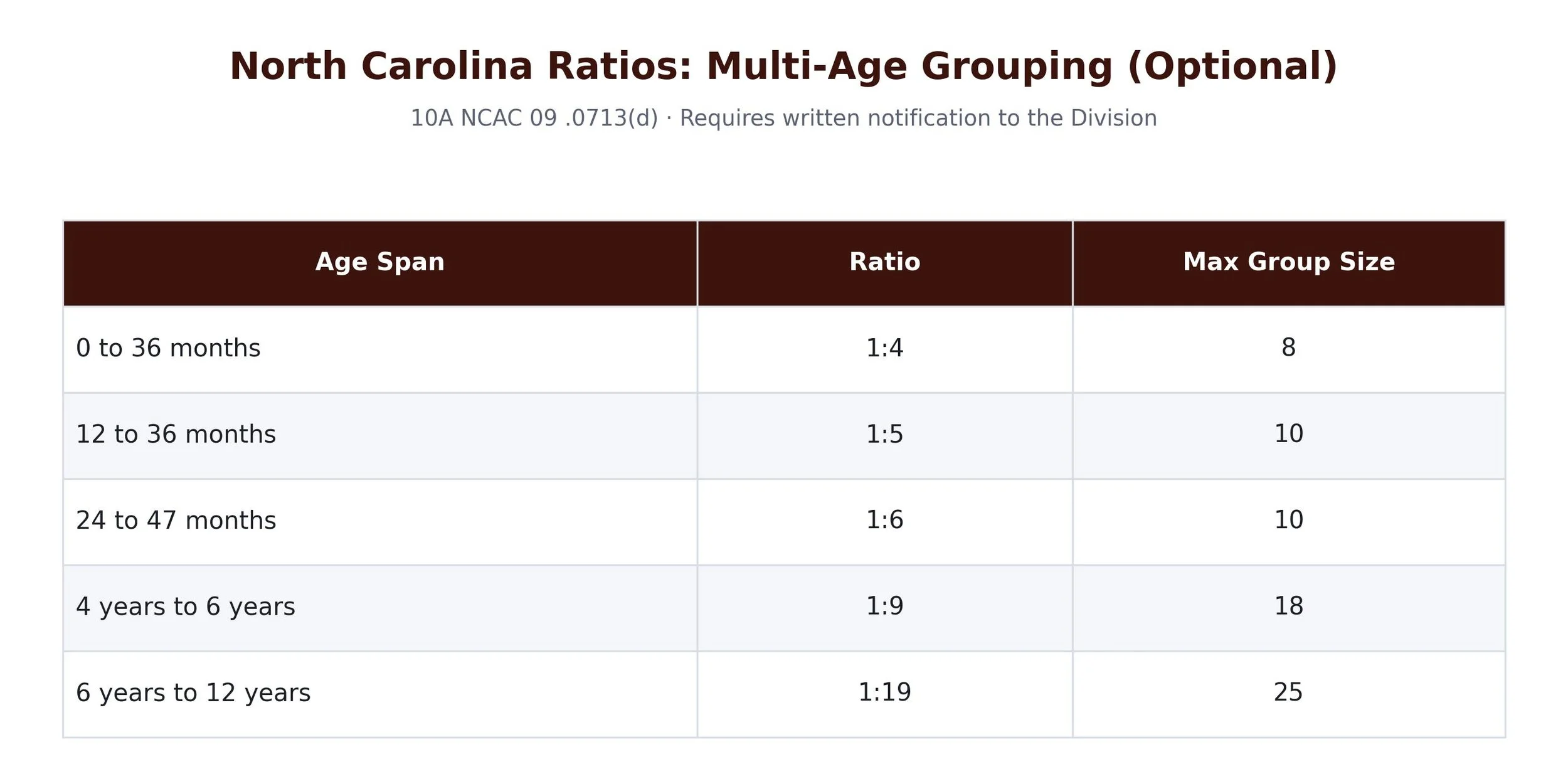
The tradeoff is visible at a glance: multi-age grouping buys developmental flexibility (children of genuinely different ages in one room by design, rather than as an exception) at the cost of significantly tighter ratios and much smaller groups. A center electing this regime operates under paragraph (d) instead of paragraphs (a) through (c), not in addition to them. It is a genuine either/or.
Mixed-Age Rules Under Single-Age Grouping (§.0713(a)(1) through (6))
For centers on the standard single-age regime, combining ages is still permitted in specific circumstances:
Combined groups: the youngest child present governs the ratio for the entire group.
All ages together: permitted during the first and last operating hour of the day, with the youngest-child ratio maintained throughout.
Under-1 separation: children under 12 months must be kept separate from children 2 and older, except during that first/last hour window or under a physician-certified developmental placement.
The 12-to-24-month restriction: children in this band cannot be grouped with older children unless every child in the group is under 3.
One-child-up exception: a developmentally ready child aged 2 or older may be placed one age level above their chronological age without affecting that group's ratio. This is limited to one child per group, so it is a narrow accommodation rather than a general flexibility.
Floor Space, and a Discrepancy Worth Understanding
North Carolina's indoor space figure is a place where secondary sources genuinely conflict, and the reason is worth explaining because it affects how you read almost any NC compliance guide.
Indoor (statutory minimum): 25 square feet per child, set by N.C. Gen. Stat. §110-91(6). This is the mandatory licensing standard. No center may be licensed for more children than its primary indoor space accommodates at 25 square feet per child, per DCDEE's own provider guide.
Indoor (enhanced tier): 30 square feet per child. You will see this number cited in some sources as though it were the baseline. It is not. It belongs to North Carolina's star-rated license enhanced standards, which programs opt into voluntarily to earn additional quality points. A center can be fully licensed at 25 square feet and simply not be pursuing the higher star rating.
Outdoor: 75 square feet per child using the outdoor play area at any one time.
If a guide tells you North Carolina requires 30 square feet indoors without mentioning star ratings, it has quietly merged a voluntary enhanced standard with the legal minimum. That distinction matters if you are calculating licensed capacity for a building.
A Bit of History
North Carolina's child care regulation traces back to the Child Care Act (N.C. Gen. Stat. Chapter 110, Article 7), which established the statutory framework including the §110-91 mandatory standards. The ratio table itself has been revised periodically, most recently in the November 1, 2024 amendment to §.0713.
The star-rated license system is worth understanding as a North Carolina hallmark: rather than a single pass/fail licensing bar, NC layers a voluntary quality-rating structure on top of the mandatory minimums, awarding points for program standards and staff education that exceed the licensing floor. This is why NC has, in effect, two sets of numbers floating around for the same thing, and why it is unusually easy to cite the wrong one in good faith.
Why This Is Harder to Track Than It Looks
North Carolina asks a center to make a structural election (single-age or multi-age) that changes which entire ratio table applies, then layers on a mixed-age framework with a one-child-per-group exception, then adds a voluntary quality tier with its own competing space standard. A center could be perfectly compliant under paragraph (a), read a guide describing paragraph (d), and conclude it was understaffed when it was not. Or it could read a star-rating space figure, assume 30 square feet was mandatory, and under-license its own building. That is exactly the kind of regime-dependent logic Ratios App is built to resolve automatically, rather than leaving an operator to work out which of North Carolina's two rulebooks (and which of its two space standards) actually applies to them.
References & Sources
N.C. Gen. Stat. §110-91 - Mandatory Standards for a License (NC General Assembly)
10A NCAC Chapter 09 - Child Care Rules (NC Office of Administrative Hearings)
NC Division of Child Development and Early Education - Provider Resources
Disclaimer: This guide reflects North Carolina 10A NCAC Chapter 09 and N.C. Gen. Stat. §110-91 as researched and is intended as a general reference, not legal advice. Always verify current requirements against the official North Carolina Administrative Code or your licensing consultant for your specific program.