Georgia Child Care Staff-to-Child Ratios: The Complete Rule 591-1-1-.32 Guide
Georgia's child care learning centers are regulated by Bright from the Start: Georgia Department of Early Care and Learning (DECAL), under Ga. Comp. R. & Regs. Rule 591-1-1-.32. A "Child Care Learning Center" in Georgia specifically means a facility serving 19 or more children; smaller operations fall under different provisions within the same chapter, with some rules (like the group-size cap) explicitly not applying to centers of 18 or fewer.
Current Ratios and Group Sizes (Rule 591-1-1-.32(1))
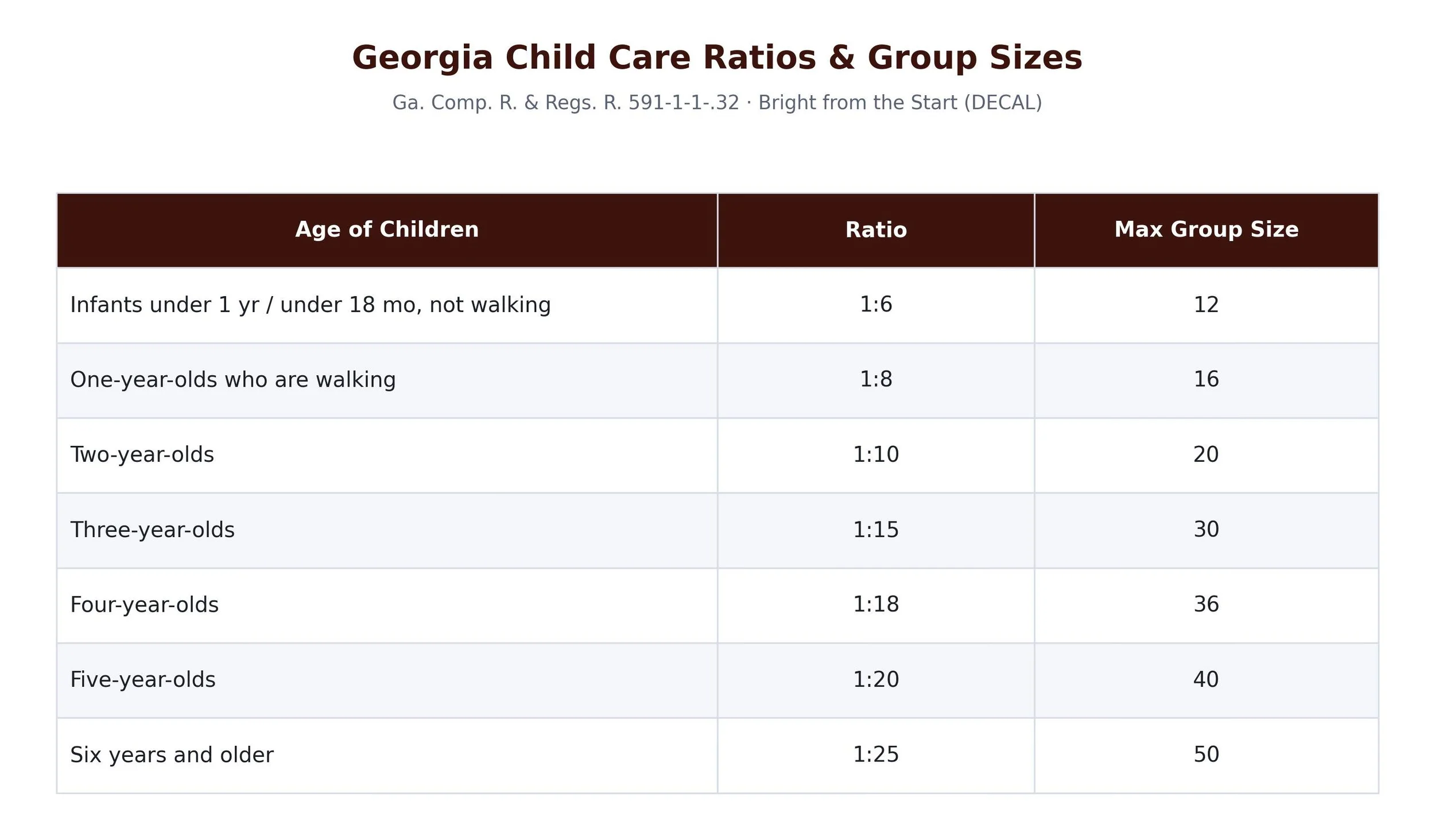
These are, across the board, some of the most lenient ratios of any US state, a Georgia five-year-old classroom can legally run at 1:20, and school-age care tops out at 1:25 with a 50-child group cap. If you're comparing Georgia to a stricter state like Pennsylvania (1:15 max for older school-age, capped at 30) or New York State (1:9 for five-year-olds, capped at 24), the gap is substantial rather than marginal.
Two built-in exceptions to the group-size numbers above, both written directly into the rule: the maximum group size does not apply during outdoor play on the center's regular playground or during special activities lasting two hours or less, and it does not apply at all to centers with a licensed capacity of 18 or fewer, though the staff/child ratio itself must still be maintained in every case.
Mixed-Age Groups: A Genuinely Distinctive Rule
Georgia's mixed-age handling is one of the more structurally unusual approaches researched for this series, and it depends on the center's licensed capacity:
For centers of 19 or more children (Rule 591-1-1-.32(2)): the ratio for a mixed-age group is based on the age of the youngest group of children that makes up more than 20% of the total number of children in the mixed-age group. This is meaningfully different from a simple "youngest child present" rule; a single toddler visiting a room of fifteen preschoolers wouldn't, on its own, drag the whole room down to toddler ratio, because that one child doesn't clear the 20% threshold. It's a proportional test, not a floor set by any single child's age.
For centers of 18 or fewer children (Rule 591-1-1-.32(3)): a simpler rule applies instead; the youngest child under 3 sets the ratio for whichever group that child is in, and once every child in a group is 3 or older, the ratio follows the age of the majority of children in that group.
Physical separation requirement: in centers of 19 or more, children under 3 must be housed in physically separate areas from older children and generally cannot be mixed with them, with two specific, narrow exceptions: during early morning arrival and late afternoon departure windows (provided ratio and group size still follow the youngest child present), and for children who turn 3 partway through the school year, who may remain with their existing 2-year-old group for the rest of that year if the parent agrees and it's developmentally appropriate for the child.
Rest-period doubling: for children 3 and older, ratios may be doubled during scheduled rest or sleep periods, provided at least one staff member remains in each room and all statutorily required staff stay on-site and available. A similar doubling applies during evening and night-time care once a majority of children are asleep.
Floor Space
Indoor (O.C.G.A. §20-1A-10 / Rule 591-1-1-.19): 35 square feet of usable space per child, excluding kitchens, bathrooms, closets, halls, storage, offices, staff rooms, and space occupied by adult-sized furniture. A narrower exception allows 25 square feet per child for children 3 and older, but only during two one-hour periods per day.
Outdoor (Rule 591-1-1-.26): the minimum outdoor area must equal 100 square feet multiplied by one-third of the center's licensed capacity, and at least 100 square feet must be available for each child actually occupying the outdoor space at any one time; centers may rotate groups through the space to satisfy this rather than needing every enrolled child accommodated simultaneously.
A Bit of History and a Word of Caution on Aggregator Sites
Georgia's ratio rule traces its authority to O.C.G.A. §20-1A-1 et seq., with the current version of Rule 591-1-1-.32 most recently amended September 20, 2020 (prior amendments in 2015 and 2017). "Bright from the Start" itself, the public-facing name for DECAL, was established as Georgia moved early care and learning out of the Department of Human Resources and into its own dedicated early-childhood agency, a structural move similar in spirit to what Illinois is now doing with its planned 2027 shift to IDEC.
One specific flag worth calling out here: this project encountered at least one aggregator site during research that badly misstated Georgia's numbers, listing figures like "infant 1:5, toddler 1:4, preschool 1:11" and a "50 sq ft indoor / 70 sq ft outdoor" space standard, none of which match the actual codified rule. Georgia's real infant ratio is 1:6, not 1:4 or 1:5 as some third-party sites claim, and the real indoor space figure is 35 square feet, not 50. This is exactly the kind of secondhand error that spreads across directories and franchise-training materials without anyone tracing it back to the actual regulation, which is precisely why every figure in this guide is sourced to the codified rule text itself rather than a summary site.
Why This Is Harder to Track Than It Looks
Georgia's headline ratios are simple to read off a table, but the mixed-age framework underneath is genuinely more sophisticated than most states': a 20%-of-group threshold test (rather than a strict youngest-child rule) for larger centers, an entirely different majority-age rule for smaller ones, and a physical separation requirement for under-3s with narrow, date-sensitive exceptions. A center operator moving from a "youngest child governs" state, which is most of them, could easily misapply that more familiar rule in Georgia and end up understaffing a room that Georgia's actual proportional test would have allowed to run leaner. That's exactly the kind of state-specific logic Ratios is built to apply correctly and automatically, rather than assuming every state's mixed-age rule works the same way.
References & Sources
Ga. Comp. R. & Regs. R. 591-1-1-.32 — Staff:Child Ratios and Supervision (Cornell LII)
Ga. Comp. R. & Regs. R. 591-1-1-.26 — Playgrounds (Cornell LII)
Georgia Administrative Code Rule 591-1-1 — Official Rules Portal (Georgia Secretary of State)
Disclaimer: This guide reflects Georgia Ga. Comp. R. & Regs. Rule 591-1-1-.32 and related rules as researched and is intended as a general reference, not legal advice. Always verify current requirements against the official Georgia Administrative Code or your licensing representative for your specific program.