Ohio Child Care Staff-to-Child Ratios: The Complete ORC §5104.033 Guide
Ohio sets its child care ratios directly in state statute, Ohio Revised Code §5104.033, with the administrative rule, Ohio Administrative Code 5180:2-12-18, restating the same figures in an Appendix A chart that centers are required to post. If you find older material citing "5101:2-12-18," that's the same rule under its prior chapter prefix, from before Ohio's ongoing agency reorganization (more on that below).
Current Ratios by Age Category (ORC §5104.033(A))
Maximum Group Size (ORC §5104.033(A))
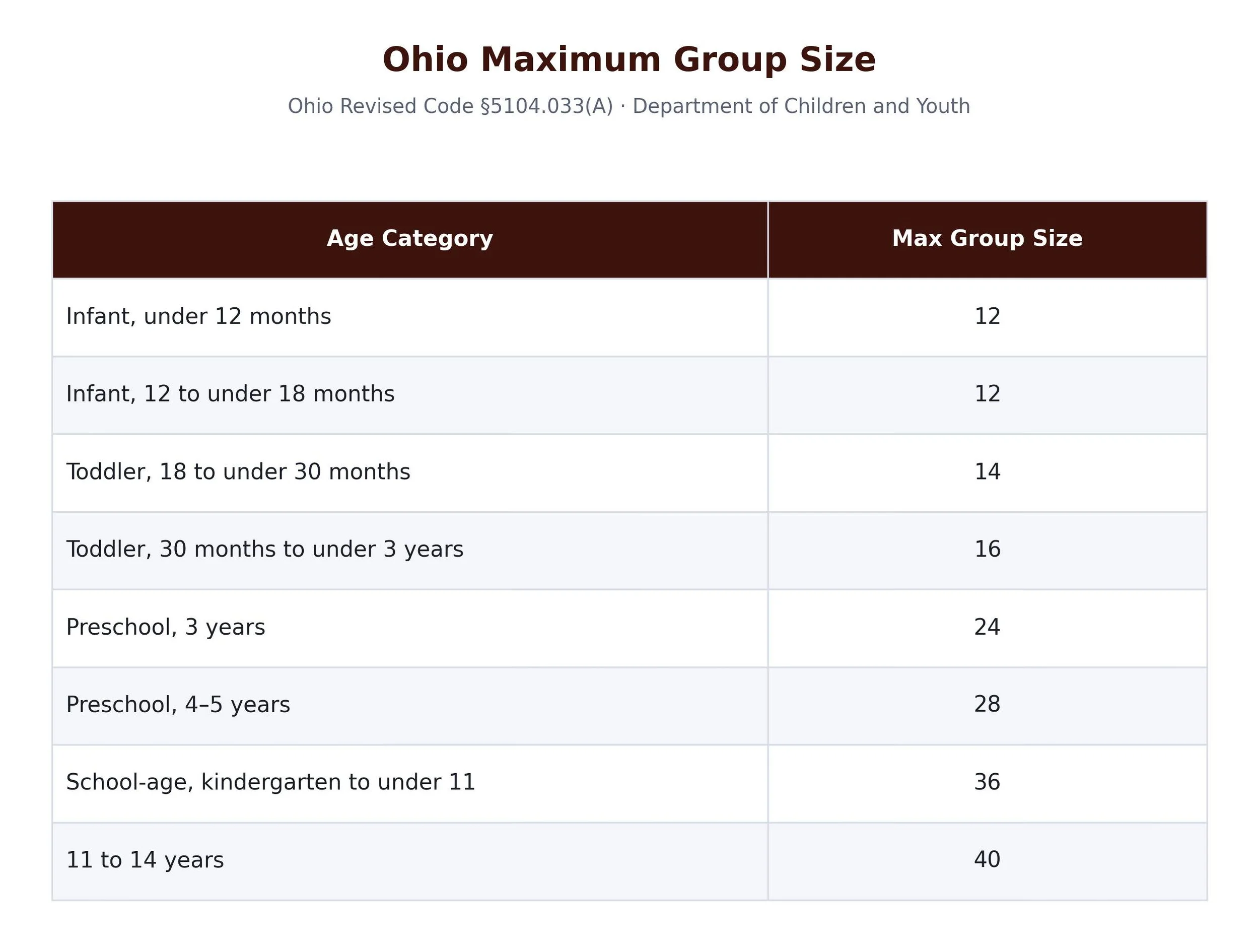
Ohio caps group size at every age band, not an uncapped state.
The Codified Two-Staff Infant Exception
Here's a detail worth knowing well: the under-12-months ratio is written as 1:5, but Ohio's statute includes a specific, codified carve-out, when two staff members are present in the same infant room, the room may care for up to 12 infants, rather than the 10 you'd get by simply doubling 1:5. This isn't a rounding artifact; it's an intentional exception built directly into §5104.033(A), effectively giving centers a modest efficiency gain once a second qualified staff member is added to the room, up to the group's overall 12-child cap.
Mixed-Age Groups and Flexibility Rules (ORC §5104.033(B))
Combined groups: when two or more age groups share a room, ratio and group size follow the youngest child present, the standard approach used by most states.
The "one older child" exception: if no more than one child aged 30 months or older is permanently assigned to a group where every other child belongs to the next-older age bracket, that one child doesn't drag the whole room down to the younger ratio; instead, the older group's ratio and group size apply to the room. This is a genuinely unusual softening; most states have no equivalent single-child carve-out.
Small centers: children of all ages may be combined into one group when a center has 12 or fewer children total.
Naptime doubling: the toddler/preschool ratio may double during scheduled rest periods, provided a staff member remains in the room and enough additional staff are on the premises to restore full ratio immediately if needed, capped at 2 hours per day.
Group-size exemptions: the maximum group size figures above don't apply during nap time, evening sleep time, meals, snacks, outdoor play, field trips, routine trips, or special occasions, though the underlying staff/child ratio must still be maintained throughout.
School-age access exception: in programs serving only school-age children, one of two required staff members may briefly leave the room to let a child into the program, provided both staff carry a working communication device and the departing staff member returns promptly.
Floor Space (ORC §5104.032)
Indoor: 35 square feet of usable wall-to-wall floor space per licensed child, excluding bathrooms, hallways, and storage. A grandfather exception applies to licenses continuously maintained since September 1, 1986, which may count some of that otherwise-excluded space.
Outdoor: 60 square feet per child using the outdoor space at any one time, and the area must be fenced or otherwise protected from traffic.
Outdoor exemption: a center may skip on-site outdoor space entirely if it maintains a separate indoor recreation area of at least 1,440 square feet (with at least 60 square feet per child using it) plus regular access to a nearby park or playground.
A Bit of History: A Regulator Mid-Transition
Ohio's child care licensing has historically sat with the Department of Job and Family Services (ODJFS). That's changing: Ohio created a new Department of Children and Youth (DCY), and child care licensing authority has been migrating there over the past few years. As of this writing, the transition is effectively complete on the rule-citation side; current, actively maintained rules use the 5180:2-12 chapter prefix, replacing the older 5101:2-12 numbering. You'll still encounter both prefixes referenced across older PDFs, training materials, and some cross-references within the code itself, since a reorganization this large doesn't get fully scrubbed from every document overnight. The underlying ratio figures in §5104.033 haven't changed because of this move, only the administrative home and the rule citation format have.
This kind of mid-transition dual-citation period isn't unique to Ohio; Texas went through something structurally similar when DFPS licensing functions moved to HHSC in 2017, and Illinois has newly-passed legislation setting up its own agency shift for 2027. It's a pattern worth watching for in any state: the regulatory numbers tend to be far more stable than the citation format used to reference them.
Why This Is Harder to Track Than It Looks
Ohio's headline ratio table is detailed but internally consistent, the real complexity is in the exceptions layered on top of it: the two-staff infant carve-out, the single-older-child softening rule, the small-center all-ages allowance, and the naptime doubling provision all interact with the base table in ways that aren't obvious from the numbers alone. Add a regulator whose citation prefix has shifted mid-stream, and it's easy for a center to be confidently compliant with an outdated rule reference while the underlying figures, which haven't actually changed, get second-guessed unnecessarily. That's exactly the kind of layered, versioned compliance check The Ratios App is built to keep current automatically.
References & Sources
Ohio Revised Code §5104.033 — Staff-to-Child Ratios and Group Size (Ohio Laws)
Ohio Revised Code §5104.032 — Space Requirements (Ohio Laws)
Ohio Department of Children and Youth — Licensing and Certification Rules
Disclaimer: This guide reflects Ohio Revised Code §5104.033 and related administrative rules as researched and is intended as a general reference, not legal advice. Always verify current requirements against the official Ohio Revised Code, Ohio Administrative Code, or your licensing representative for your specific program.