Michigan Child Care Staff-to-Child Ratios: The Complete R 400.8222 Guide
Michigan's child care centers are licensed by the Child Care Licensing Bureau (CCLB), which now sits inside the Department of Lifelong Education, Advancement, and Potential (MiLEAP), a department created in 2024. The governing rules are the Licensing Rules for Child Care Centers, Mich. Admin. Code R 400.8101 et seq., and they went through a major revision effective May 7, 2025.
Before the numbers, a warning that genuinely matters for Michigan more than for most states: these rules have been renumbered twice. If you are reading a guide, a training packet, or a franchise handbook that cites R 400.5105, R 400.5116, R 400.8157, or R 400.8167, you are looking at a stale citation from either the 2008 or the 2014 rule set. The current citations are R 400.8222 (ratios and group size), R 400.8121 (indoor space), and R 400.8125 (outdoor space). Several widely-read aggregator sites are still publishing the old rule numbers alongside old figures.
Current Ratios and Group Sizes (R 400.8222, Table 1)
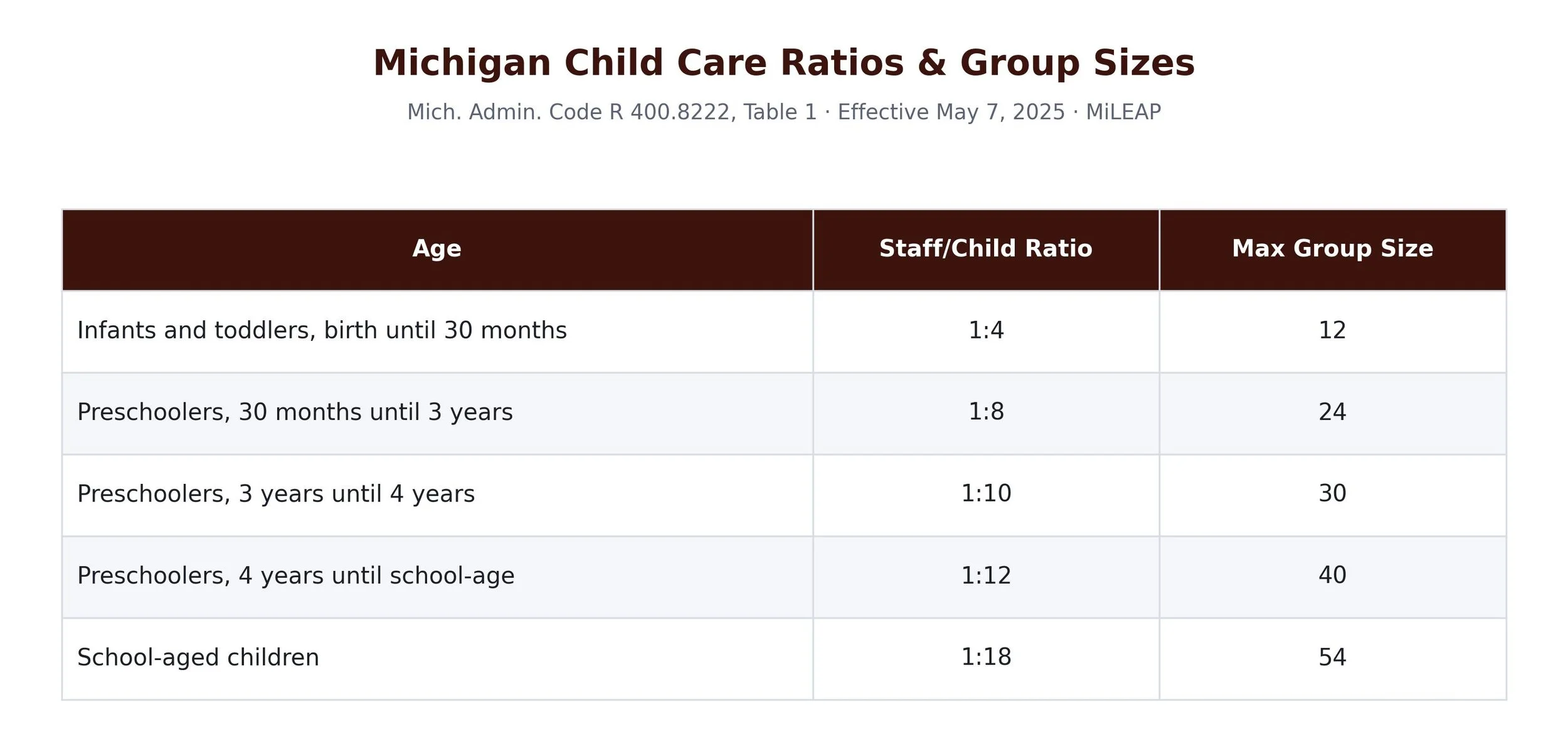
Michigan does cap group size, and those caps are large by national standards (up to 54 for school-age). Worth flagging: some aggregators are still publishing the old caps from the pre-2025 rules (showing 16 for the 30-month band, 30 for 4-year-olds, and 36 for school-age). The figures above are the current ones. If a source is showing you a school-age cap of 36, it is out of date by more than a year.
Baseline Staffing Floors (R 400.8222(2) and (3))
Separate from the ratio table, Michigan sets two hard staffing minimums that can require more coverage than the ratio alone would suggest:
At least 2 adults, one of whom must be a child care staff member, whenever 3 or more children between birth and 3 years old are present.
At least 2 adults, one of whom must be a child care staff member, whenever 7 or more children over 3 years old are present.
A room with three infants technically satisfies the 1:4 ratio with one staff member, but Michigan still requires a second adult present. This is the kind of rule that a ratio calculator alone will miss.
Mixed-Age Groups (R 400.8222(8))
Michigan uses a youngest-child governs rule, with an important carve-out: the youngest child sets the ratio and group size for the whole room unless each age group is clearly separated and the correct ratio and group size are independently maintained for each group. In other words, physical separation within a room can preserve separate ratios rather than forcing the entire space down to the youngest child's standard, which is a more flexible construction than most states offer.
Age-Transition Allowances (R 400.8222(5) through (7))
Michigan builds in three explicit early-promotion allowances, each requiring written parental permission and a developmental-appropriateness judgment:
Children who have reached 33 months may enroll in a 3-year-old classroom (1:10 applies).
Children who have reached 45 months may enroll in a 4-year-old classroom (1:12 applies).
Children who have reached 57 months but are not yet school-age may enroll in a school-age classroom (1:18 applies).
These matter operationally, because a child promoted early carries the receiving room's ratio, not their chronological age band's ratio. That is a real efficiency lever for a center managing enrollment.
Naptime Supervision (R 400.8222(9))
When all children in a room are asleep, a single staff member may supervise, provided: that staff member does nothing but supervise, every child is visible to them, additional staff are present at the center and close enough to intervene immediately, and full ratios are restored the moment the first child wakes.
Small Capacity Centers (R 400.8222(14) and (15))
Michigan carves out an entirely separate, simpler regime for small capacity centers, which are exempt from subrules (2) through (11) (meaning the main ratio table, the two-adult floors, and the mixed-age rules all fall away). Instead:
Minimum ratio of 1:6, or 1:10 if the center operates a Great Start Readiness preschool program and serves only children enrolled in that program.
No more than 4 children under 30 months per staff member.
Maximum group size of 20.
Floor Space
Indoor (R 400.8121):42 square feet per child for infants and toddlers, and 35 square feet per child for preschoolers and school-aged children. Note that some aggregator sites claim 50 square feet for infants. That figure does not appear in the codified rule; the actual number is 42.
Outdoor (R 400.8125): Michigan is structurally unusual here. It does not use a per-child outdoor figure. Instead, a center operating with children in attendance for 3 or more continuous hours per day must have an outdoor play area of not less than 1,200 square feet total, with more than 1,200 square feet potentially required if that minimum is not adequate for the licensed number of children. Almost every other state in this series sets a per-child outdoor number. Michigan sets a floor on the total area instead.
A Bit of History: A Department That Did Not Exist Two Years Ago
Michigan's child care licensing has moved around a lot. It sat with the Department of Licensing and Regulatory Affairs (LARA), then with the Michigan Department of Education, and in 2024 it moved again into the newly created MiLEAP, a department built specifically to consolidate early childhood, K-12 support, and higher education functions. The May 7, 2025 rule revision (2025 MR 10) followed shortly after, renumbering and re-tabling large portions of the rules. There was even a formal correction issued afterward: an acknowledged error in R 400.8222 as originally published in 2025 MR 10 was corrected at the promulgating agency's request, with the correction memorandum published in 2025 MR 11.
That sequence (new department, major rule revision, published correction to the revision) is a compact illustration of why Michigan is one of the harder states to cite confidently right now. The numbers are stable and knowable. The paper trail is genuinely messy.
Why This Is Harder to Track Than It Looks
Michigan is arguably the strongest case in this entire series for why a maintained, primary-sourced reference beats a static PDF. Within about two years, the state stood up a new licensing department, renumbered the rules for the second time in a decade, revised the actual ratio caps upward, and issued a formal correction to its own published revision. Meanwhile, well-trafficked third-party guides are still serving the 2014 rule numbers with pre-2025 group-size caps and an infant floor-space figure that was never in the code. A Michigan operator relying on any of that would be planning capacity around numbers that are simply wrong. That is exactly the problem Ratios App exists to solve: one source, current, traceable back to the codified rule.
References & Sources
Mich. Admin. Code R. 400.8222 - Capacity, Ratio and Group Size (Cornell LII)
Mich. Admin. Code R. 400.8222 - Full Rule Text (Justia Regulations)
Disclaimer: This guide reflects Michigan's Licensing Rules for Child Care Centers as researched and is intended as a general reference, not legal advice. Always verify current requirements against the official Michigan Administrative Code or your licensing consultant for your specific program.