Texas Child Care Staff-to-Child Ratios: The Complete Chapter 746 Guide
Licensed child care centers in Texas operate under Texas Administrative Code, Title 26, Part 1, Chapter 746 — Minimum Standards for Child-Care Centers, enforced by the Health and Human Services Commission's Child Care Regulation division (HHSC CCR). The rules are detailed, but the structure is genuinely straightforward once you know where to look; Texas is one of the more consistently organized states in the country when it comes to ratio compliance.
Current Ratios by Age Group (§746.1601)
Texas uses the same ratio indoors and outdoors; there's no separate outdoor multiplier to track, which simplifies compliance compared to states that adjust the ratio by setting.
Maximum Group Size (§746.1609)
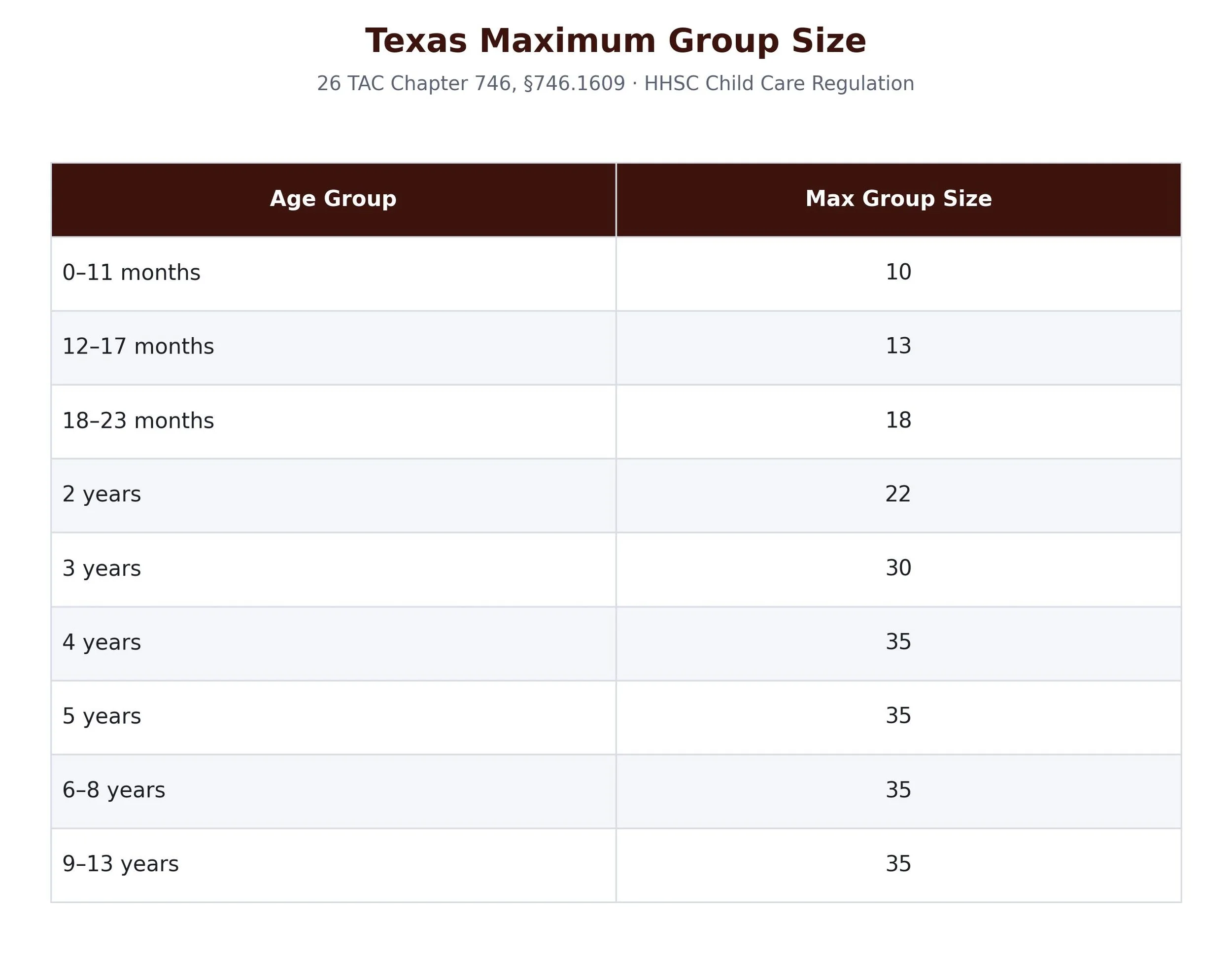
Texas does cap group size (up to 35), and importantly, adding a second caregiver to a room does not raise that cap. Group size is a hard ceiling under §746.1607, independent of how many staff are present.
Mixed-Age Groups and Flexibility Rules
Texas has more built-in flexibility for mixed-age and transitional situations than many states, spread across a few adjacent sections:
Combining infants with 18-month-olds and older (§746.1605): allowed under specific conditions rather than a blanket prohibition.
Temporary group combination for joint activities (§746.1611): groups may combine, for meals, naptime, field trips, and outdoor play, for the full duration of the activity. For other joint activities, toddlers through 4-year-olds can combine for up to 30 minutes, and children 5 and older for up to 90 minutes. The ratio for each individual group must still be maintained even while combined.
Opening and closing ratio adjustment (§746.1615): during the first and last 45 minutes of the operating day, typically the lowest-attendance windows, centers may relax the ratio for children 18 months and older to 1 caregiver per 16 children. This adjustment does not apply to children under 18 months, who must maintain their standard ratio at all times.
That last rule is a distinctly Texas feature; very few states codify a specific opening/closing ratio relaxation, and it reflects a practical acknowledgment that early-morning and late-evening headcounts are usually much lower than midday peak.
Floor Space
Indoor: minimum 30 square feet of indoor activity space per licensed child (§746.4201), excluding restrooms, kitchens, hallways, and storage areas. A legacy exemption allows 20 square feet for kindergarten/nursery space licensed before September 1, 2003, not available to new applicants.
Outdoor: minimum 80 square feet per child using the outdoor area at any one time, and total outdoor space must equal at least 25% of the center's total indoor licensed capacity (§746.4203 / §746.4305).
A Bit of History: Why Texas Cites "Title 26" Now
If you find an older document, PDF, or aggregator site citing Texas ratios under "Title 40," that source is out of date; here's why: Child care licensing in Texas was originally handled by the Department of Family and Protective Services (DFPS). Senate Bill 200 in 2015 began consolidating Texas's health and human services agencies, and House Bill 5 in the 2017 legislative session made DFPS a standalone agency separate from the broader HHS system, but as part of that same reorganization, the actual regulatory function for child care licensing moved to the Health and Human Services Commission (HHSC), effective September 1, 2017. DFPS retained responsibility for investigating abuse and neglect allegations, but day-to-day licensing and the Minimum Standards themselves became HHSC's job.
That transfer required physically relocating the rule text in the Texas Administrative Code, from its old home in Title 40 to a new location under Title 26, Part 1, completed effective March 9, 2018. The ratio numbers themselves weren't rewritten in this move; only their citation changed. But it means the specific section numbers you'll see cited today (§746.1601, §746.1609, and so on) are only about seven years old as citations, even though the underlying Minimum Standards program is much older.
Texas HHSC also assigns each minimum standard a documented risk weight, high, medium-high, medium, medium-low, or low, reflecting how serious a violation of that particular standard is considered. Ratio and supervision requirements are treated as high-risk standards, which is reflected in how aggressively they're enforced during inspections relative to more administrative requirements.
Why This Is Harder to Track Than It Looks
Texas's numbers are clean, but keeping them straight in practice means tracking three interacting rules simultaneously: the base ratio, the independent group-size cap, and whichever flexibility exception might apply at a given moment (opening/closing, joint activities, or combined groups during meals and naptime). A center operating at exactly its group-size cap during a joint outdoor-play combination, for instance, has to know that the individual group ratios still apply even though the room briefly holds more children than any one group's normal capacity. Add periodic amendments; Chapter 746 sees regular revision memos from HHSC, most recently around parent-rights disclosures and administrator licensing, and it's easy for a center to be technically compliant on the headline ratio number while missing a supporting rule that changes the picture. That's exactly the kind of layered compliance check The Ratios App is built to run automatically, rather than leaving directors to cross-reference multiple sections of Chapter 746 by hand.
References & Sources
Minimum Standards for Child-Care Centers, Chapter 746 — Consolidated PDF (Texas HHSC)
Chapter 746, Live Section-by-Section Code (Justia Regulations)
DFPS Rule Transfer Notice — Texas Secretary of State, Texas Register
Minimum Standards Overview — Texas Health and Human Services
Disclaimer: This guide reflects Texas Chapter 746 regulations as researched and is intended as a general reference, not legal advice. Always verify current requirements against the official Texas Administrative Code or your licensing representative for your specific program.