New York Child Care Ratios: Why New York City and New York State Play by Different Rules
Most states have one rulebook for licensed child care centers. New York has two, and they don't agree with each other. If you're opening or running a center in Manhattan, Brooklyn, Queens, the Bronx, or Staten Island, you're operating under New York City Health Code Article 47, enforced by the Department of Health and Mental Hygiene (DOHMH). Everywhere else in the state, centers fall under 18 NYCRR Part 418-1, enforced by the Office of Children and Family Services (OCFS). The two instruments define age bands differently, set different ratios, cap group sizes differently, and even disagree on how to handle mixed-age classrooms. Here's the full breakdown of both, and why the gap between them exists.
New York City (Article 47, §47.23)
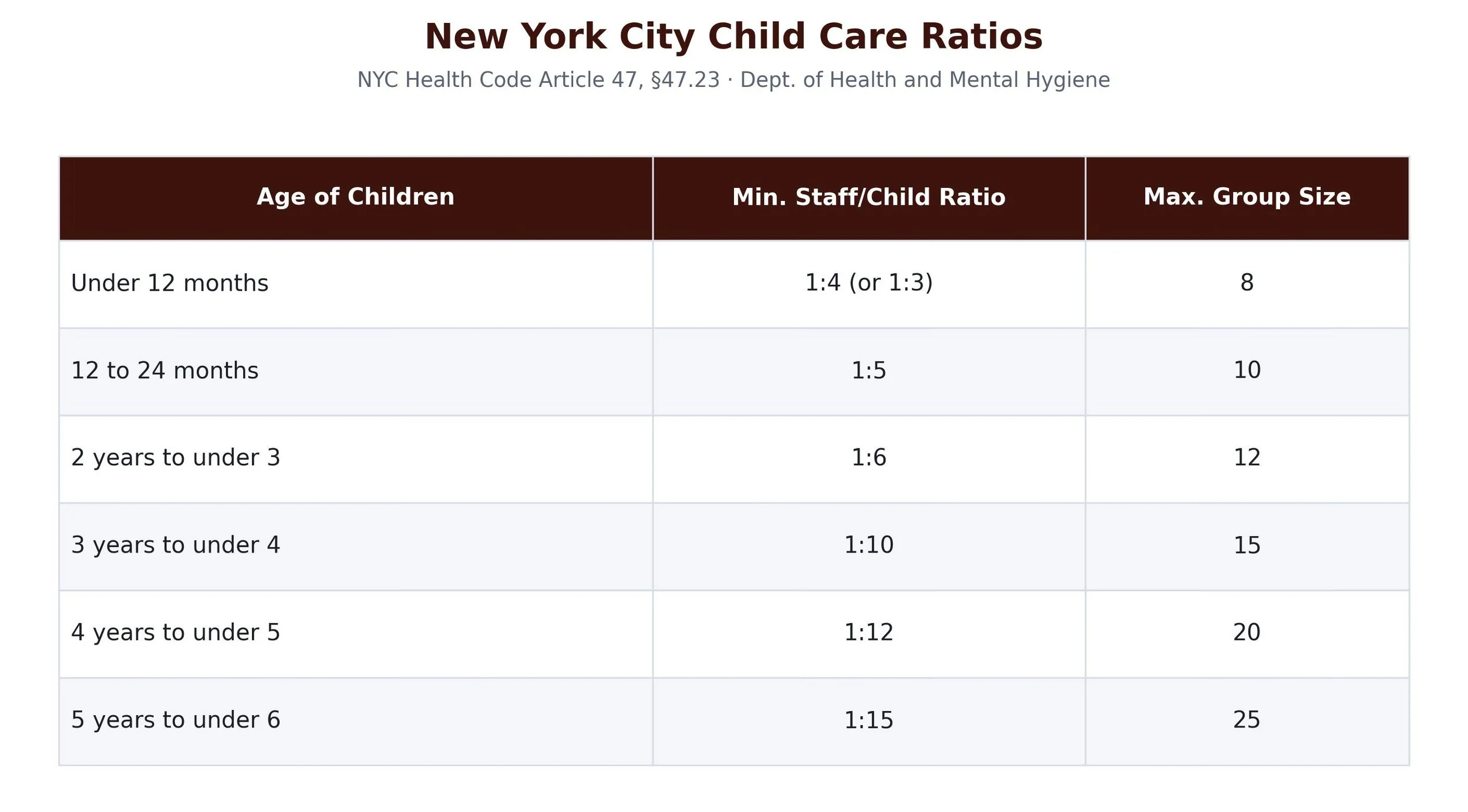
Mixed-age groups (NYC): when children 12 months and older share a room in a mixed but contiguous age range, the ratio and group size are based on the predominant age of the children in the group, not the youngest child present.
New York State, outside NYC (18 NYCRR §418-1.8)
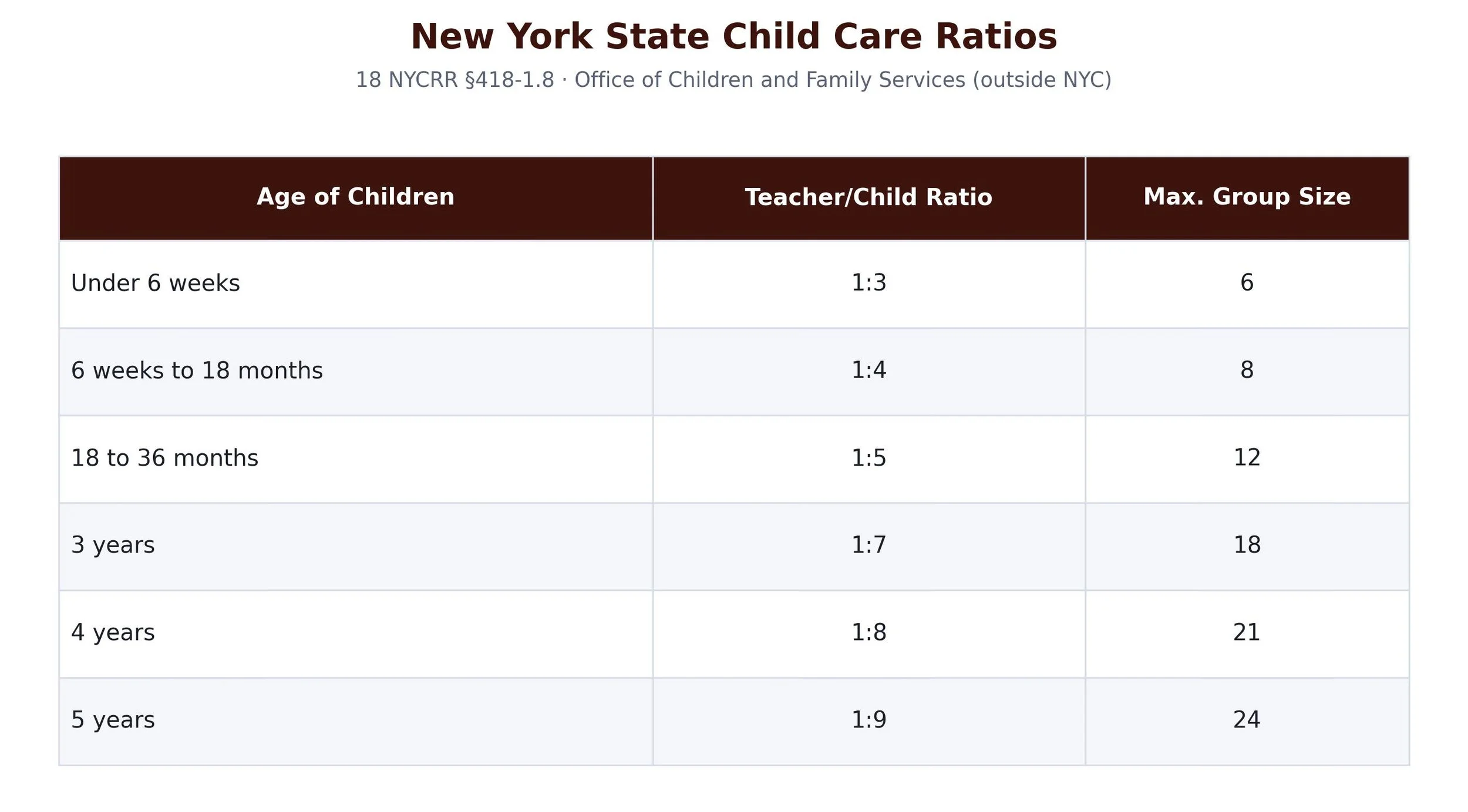
Mixed-age groups (state): the opposite rule applies. When toddlers are cared for with preschool children, or preschoolers with school-age children, the ratio and group size of the youngest child in the group governs the entire room.
Where the Two Systems Actually Diverge
Laid side by side, three real differences emerge:
1. The age bands don't line up. NYC's "toddler" is defined as 12–24 months; the state's toddler band runs 18–36 months. A child who is, say, 20 months old is a "toddler" under both systems but sits in entirely different regulatory categories depending on which side of the city line the center is on.
2. Preschool ratios are meaningfully looser in NYC. For 4-year-olds, NYC allows 1 staff member per 12 children (group size up to 20); the state allows only 1:8 (group size up to 21). For 5-year-olds, NYC allows 1:15; the state allows 1:9. This isn't a rounding difference; it's close to double the permitted ratio for the same-age children, depending on which regulator has jurisdiction.
3. The mixed-age rule is inverted. NYC bases mixed-group staffing on whichever age is most common in the room; the state bases it on whichever child is youngest. A center near the city line with an identical mixed-age roster could be in full compliance under one rulebook and out of compliance under the other.
Where they agree: school-age care. Ratios for school-age children (6 and up) are governed statewide by a third instrument, 18 NYCRR Part 414 (School-Age Child Care), which DOHMH itself administers within the five boroughs under contract to OCFS. So school-age ratios are actually identical in NYC and the rest of the state: 1:10 (max group 20) through age 9, and 1:15 (max group 30) for ages 10–12. It's only the under-6 tiers where the two systems genuinely part ways.
Floor Space
NYC (Article 47, §47.39(b)): 30 square feet of wall-to-wall space per child, indoors. Outdoor space is handled very differently than almost anything else in the Code: rather than a fixed square-footage formula, §47.47(a) requires only that outdoor play areas be "adequate, easily accessible... clean and safe, and... suitable for children's use", language that is conspicuously vague compared to the specificity Article 47 uses elsewhere. That vagueness is deliberate, not an oversight: the actual gatekeeping happens earlier, at the permitting stage. Under §47.09(a)(1), every new-permit application must include a "facility pre-permit technical plan", scaled blueprints or architectural drawings showing the dimensions of every indoor and outdoor area, the intended use of each, and the outdoor space's location and distance relative to the indoor space. In effect, NYC doesn't set a number in the regulation; it evaluates each proposed outdoor space case-by-case as part of the plan approval, which is also how it accommodates the reality that a lot of NYC centers have no ability to build a private, on-premises yard.
New York State (18 NYCRR §418-1.3(q) and §414.3(i)): 35 square feet per child specifically for infant/toddler indoor play areas, excluding large-motor-activity rooms, storage, halls, bathrooms, kitchens, and offices. Unlike NYC, the state addresses off-site outdoor space head-on in the regulatory text itself rather than through case-by-case plan review: §414.3(i) states plainly that "readily accessible outdoor play space which is adequate for active play must be provided," and that "outdoor space may include public parks, school yards or public play areas", provided the center files a written diagram with OCFS showing how children will safely travel to and from the location. The same language appears verbatim across several of OCFS's Parts (414, 416, 418-1), so it's a standing statewide policy, not a one-off exception.
The upshot: both systems accept off-site public space in place of a private yard, and both ultimately require a diagram of some kind, but the mechanisms are philosophically different. New York State writes the public-park allowance directly into the regulation as a defined option. New York City never actually defines "adequate" in Article 47 at all; it just requires you to submit your specific proposal at §47.09 and get it approved on its own merits.
The History Behind the Split, and Why It's Frozen in Place
New York City has regulated its own child care programs since long before the current numbering scheme existed; Article 47 sits inside the city's Health Code because DOHMH, not the state, has home-rule authority over public health matters within the five boroughs. OCFS regulates the rest of the state under the Social Services Law.
What's kept the state side essentially unchanged for a quarter-century is a specific statutory guardrail: Social Services Law §390(2-a)(a)(iii) requires that any OCFS ratio regulation be no less stringent than what was in effect on January 1, 2000. In practice, that means the state's ratios and group sizes have stayed the same since 2000, with one narrow addition: a standard for the birth-to-6-weeks age band, which didn't exist as its own category at the time.
This has become a live legislative issue. Bills introduced in the New York State Legislature (S278/A00612, and earlier S8426) have explicitly cited the mismatch between NYC's more flexible toddler ratio (1:5, max group 12 in NYC's "predominant age" framing) and the state's 1:5-ratio-but-max-12-group toddler rule, which the bill's sponsors argue makes it financially impractical for providers outside the city to admit more than 10 children to a 12-child-capacity room, because doing so requires hiring a second full teacher for just two additional slots. The proposed fix is to let OCFS revise ratios to better match NYC's approach. As of this writing, the bill has not been enacted, so the Part 418-1.8 table above remains current, but it's a rule under active political pressure, not a settled one.
Why This Is Genuinely Hard to Track
New York isn't a "one state, one rulebook" case; it's effectively three overlapping rulebooks (Article 47, Part 418-1, and Part 414) depending on where a center sits and which age group is in the room, with two different philosophies for how to handle a mixed-age classroom. A center that opens near a jurisdictional boundary, expands into both markets, or simply misapplies the wrong age-band cutoff can be confidently compliant with one instrument and quietly out of compliance with the other. That's exactly the kind of cross-referencing The Ratios App is built to eliminate, select your jurisdiction, and the correct ratio, group size, and space requirement come back automatically, without having to remember which of New York's regulators governs your center.
References & Sources
NYC Health Code Article 47, §47.39 — Space Allowance; Reservation for Children's Use
NYC Health Code Article 47, §47.09 — Applications for Permits (American Legal Publishing)
NYC Health Code Article 47, §47.47 — Outdoor Play Areas and Facilities
New York State Child Day Care Regulations, Part 418-1 (OCFS official PDF)
NY State Assembly Bill A00612 (2025) — proposed staff/child ratio reform, with NYC/state comparison
NY State Senate Bill S278 (2025) — companion ratio reform bill
Disclaimer: This guide reflects New York City and New York State child care regulations as researched and is intended as a general reference, not legal advice. Always verify current requirements against the official Health Code, NYCRR, or your licensing representative for your specific program.